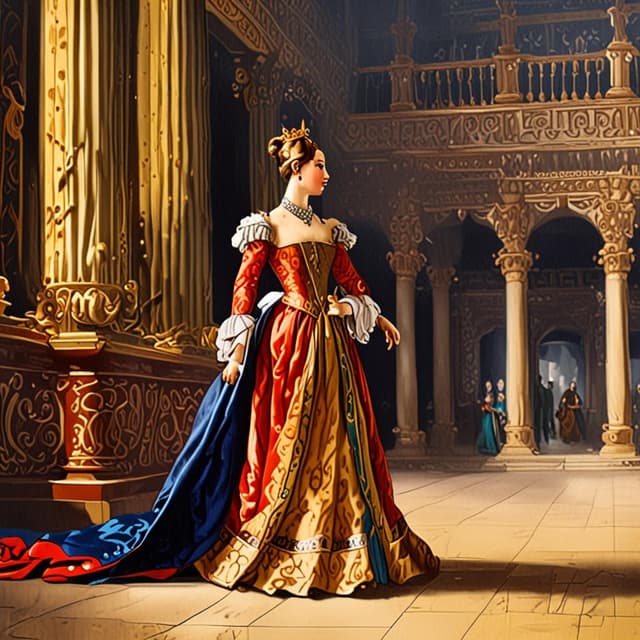
| Genre | Musical drama |
| Title | 'The King and I' |
| Themes | Imperialism • Gender • Cultural exchange |
| Setting | 19th century Kingdom of Siam (modern-day Thailand) |
| Conclusion | The musical explores the transformative power of cultural exchange, culminating in a somber and tragic conclusion to Elise and the King's relationship. |
| Plot summary | A French governess, Elise Fortier, is hired by the royal family of the Kingdom of Siam to tutor the King's many children. This sets the stage for a complex cultural clash as Elise navigates the rigid hierarchies and traditions of the Siamese court. Over time, Elise and the King develop a deep but fraught bond, as they grapple with conflicting values, customs, and perspectives on the role of women and the specter of French colonial ambitions. |
| Main characters | Elise Fortier (French governess) • The King of Siam |
"The King and I" is a musical drama that explores the complex relationship between a French governess and the King of the Kingdom of Siam (modern-day Thailand) in the 19th century. Unlike the original Rodgers and Hammerstein musical, this version does not involve the colonization of Siam by the British Empire. Instead, it focuses on the cultural clash and evolving bond between the two central characters against the backdrop of Siam's continued independence.
The Kingdom of Siam was a major power in Southeast Asia during the 1800s, maintaining its sovereignty as European colonial empires expanded across the region. Under a series of modernizing monarchs, Siam underwent rapid industrialization and administrative reforms, making it one of the most advanced and stable kingdoms in Asia.
However, Siam still retained many traditional customs and rigid social hierarchies, including an absolute monarchy with the King wielding immense power. This traditionalist culture would come into conflict with the arrival of the French governess, Elise Fortier.
In 1862, Elise Fortier, a young French aristocrat, is hired by the Siamese royal family to serve as a private tutor for the King's numerous children. Elise is initially excited by the prospect of this exotic posting, but quickly finds herself overwhelmed by the alien customs and unyielding protocols of the Siamese court.
The King, a modernizing despot who seeks to use Western knowledge to strengthen his kingdom, is intrigued by Elise's spirit and intellect. However, he is also deeply suspicious of her European origins and the potential threat of French colonial ambitions. A clash of wills ensues as Elise attempts to impart her enlightened views on the King and his family, while navigating the rigid gender norms and class hierarchies of traditional Siamese society.
Over time, Elise and the King forge an unlikely bond, bonding over a shared desire to improve their respective societies. Elise comes to appreciate the rich cultural heritage and intellectual achievements of Siam, while the King is inspired by Elise's insights on democracy, women's rights, and scientific progress.
Yet their deepening relationship also attracts the concern of the Siamese court and growing French diplomatic pressure. Elise finds herself torn between her affection for the King and her own European liberal values, which are threatened by the authoritarian nature of the Siamese monarchy.
As political tensions mount between Siam and France, the relationship between Elise and the King spirals into tragedy. In a climactic confrontation, the King rejects Elise's pleas to reform his regime, leading to a devastating rupture that leaves both protagonists bereft.
The musical's conclusion is somber and ambiguous, with no easy resolution to the cultural divides that had driven Elise and the King apart. It is a cautionary tale about the limits of cross-cultural understanding and the stubborn endurance of traditional power structures, even in the face of modernizing forces.
Through this reimagined "The King and I," audiences are invited to reflect on the complex dynamics of imperialism, gender, and the transformative potential - as well as the pitfalls - of cultural exchange between the West and non-Western civilizations.
